

Trek to Yomi is a stylistic, somewhat side-scrolling adventure that pays homage to classic samurai films like those from famous filmmaker, Akira Kurosawa. You take control of Hiroki, a young samurai from a small village who is duty bound to protect it from any who would do it, or its inhabitants harm. Through a series of events, Hiroki sets out on a journey to take revenge on those who have done just that.
The story is your pretty standard revenge tale: a defiant protagonist who suffered a traumatic experience hell-bent on avenging those that meant the most to him. That’s not necessarily a bad thing, just don’t play the game expecting something profound. As a fan of the genre, I found the story to be a sort of welcome familiarity.
Artistic Masterpiece
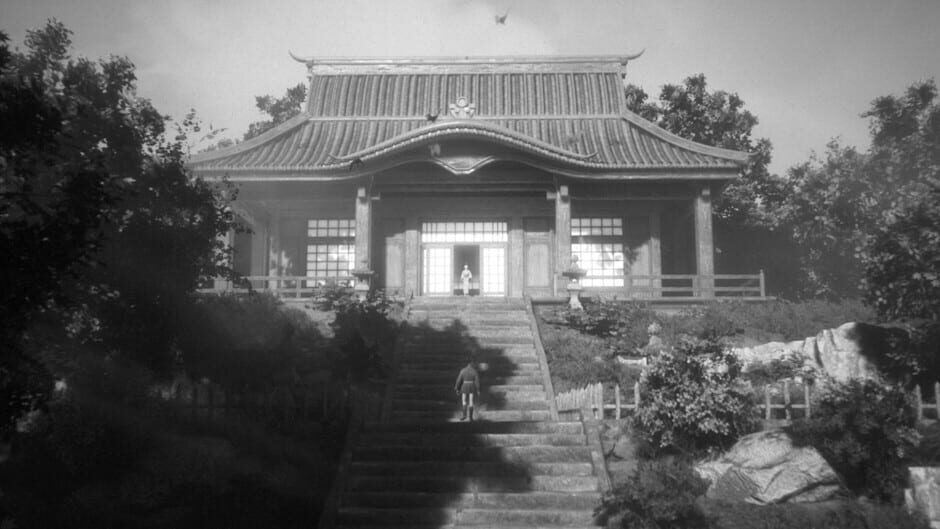
The art and aesthetic of Trek to Yomi is absolutely stunning, and by far its greatest feature. The entirety of the game is set in black and white, part of its homage to samurai films of old. Everything from the logos, to the font, and even a grainy effect that permeates the screen at times makes you feel like you’re transported back in time, enjoying a Kurosawa masterpiece. It feels like you’re running the game on actual film instead of digitally or on a disc. Seeing Hiroki and his enemy silhouetted against a backdrop of the night sky or a raging fire never gets old. The game is an outright treat to behold visually.

The atmospheric storytelling is on point throughout the game. As you traverse the village and other locales, fire from a burning building sways in the background, crackling as you pass. Villagers try their best to hide from ruthless bandits, some succeeding and some less fortunate. Bodies are strewn through the streets with bandits rifling through the robes of the unfortunate, looking for anything of value. These little additions go far in helping build the immersion for the player. The lighting and shadows are used to great effect throughout the game, and the audio does a good job of reinforcing that feeling of playing through those classic samurai films.
Another very cool and unique feature of Trek to Yomi is the developer’s use of depth of field. At first glance the game looks like a side-scrolling action game, but it’s actually much more akin to the tank controls and camera angles of prior Resident Evil games. In the exploration sections, you can actually move the character toward or further away from the screen. What this does is bring things into focus that you may not have noticed before. Several times throughout the game I found hidden ammo, or a secret path that was hard to notice until you change your character’s depth in the current scene. I don’t think I’ve seen this specific feature used better in any game that comes to mind.

Held Back by Gameplay
While we’ve established that Trek to Yomi is visually and artistically stunning, it’s in its other gameplay mechanics where the game falls short. While the combat was satisfying at times, in the long run it was highly unfulfilling and never had the weighty feel I was expecting, especially after playing other samurai games such as Sekiro: Shadows Die Twice. It may not be fair to compare the two, but I couldn’t help doing so throughout the game when it came to the combat. Trek to Yomi boasts a host of combos, a parry system, and even a dodge, but none of it feels necessary. I found myself using one combo throughout the entirety of the game, and only using the dodge roll during boss encounters. The parry can be useful, but again is rendered unnecessary. It was as simple as just blocking the first two attacks of an enemy, then using your go-to combo. It’s a shame that the combat felt like such an afterthought compared to the visual representation of the game.
Boss encounters provided the only real fun I had with the game’s combat system. Instead of blocking and using the same combo, I was forced to learn the various boss’ attack patterns and dodge them while trying to land a few hits, then repeat the process. It was much more satisfying and actually pushed me to use another mechanic that I literally did not use at all throughout the game: ranged weapons. You have three ranged weapons to choose from, but I only used them during boss battles because the regular fights throughout the game were easy enough to forget I even had the option.

Trek to Yomi suffers in one final area, and that is the puzzles thrown in at random moments that felt like they were there simply for the developer to say their game has puzzles. They come late in the game, so it’s odd to suddenly have your progress blocked by a random puzzle when you had been traversing the game unhindered for so long. The puzzles themselves are extremely easy, which makes them even more annoying that it interrupts your session. The game would not have suffered if it just didn’t include these puzzles at all.
Technical Issues
As far as technical issues go, the game ran smoothly and I didn’t notice any technical hiccups like framerate issues or game breaking bugs. There were a couple of instances where the dialogue audio of some NPCs would cut out. The captions were still there and the background audio was present, but the actual audio from the NPC talking was gone. It only happened a couple times so it wasn’t a major deal in the grand scheme of things.

Verdict
Trek to Yomi accomplishes what it set out to do, and that is to be an homage to 20th century samurai films. It succeeds in so many ways visually and aesthetically, but the combat holds it back from being a must play game. I highly recommend this game if you’re a fan of legendary filmmakers like Akira Kurosawa, or if you simply find yourself with time and no other games to play. Otherwise, Trek to Yomi can easily be skipped until you find yourself out of the plethora of other great games to play.
What did you like about Trek to Yomi? What do you think they could have improved upon?

 Pixels and Pings